

You can tell how sophisticated a civilization is by how much energy it consumes, where that energy comes from, and how many financial instruments have been invented to bet on or hedge against its price.
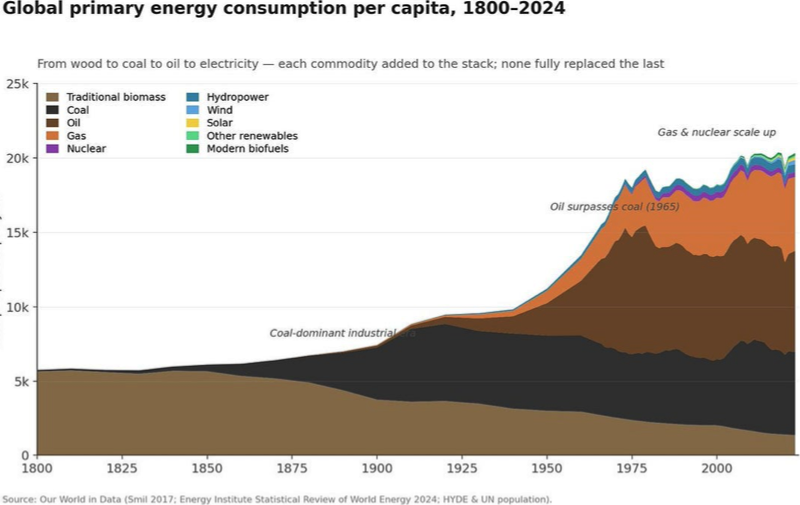
Global energy usage per capita > 4x over the last 2 centuries alone, shifting across traditional biomass, to coal, oil, gas, and now more modern renewables emerging.
Wood did the first few thousand years of work, leading to 19th-century America serving as the most wood-intensive population in recorded history. An American family of five burned a stack of wood roughly 200 feet long every year, as wood supplied 94% of US primary energy in 1800, and American railroads ran on wood-fired locomotives into the 1870s. Britain had mostly deforested itself by the 1700s, which is why Britain mined more coal than the rest of the world combined by the early 18th century. From a developmental perspective, the Industrial Revolution is what happens when a country runs out of trees.
Globally, coal went from 3-5% of primary energy in 1840 to roughly 47% by 1900, at which point it had finally pulled even with wood. Along the way, the six-decade slog produced: factories, railways, and in 1877 the London Metal Exchange (LME). Whale oil had a good run as the premium fuel source for lighting, peaking in the mid-19th century, and then getting overtaken by kerosene and by the sperm whale population’s decision to stop existing in commercial quantities. Drake is often hailed as being responsible for the demise of whaling when he struck oil in 1859, but by then, whaling was mostly already dead in the water (no pun intended). Oil had the same adoption race versus coal between 1915 and 1965, when it finally overtook coal as the world’s dominant energy source, and along the way produced the modern supply chain, OPEC (1960), and the Brent and WTI complex (the largest crude derivatives markets on Earth).
Electricity had a similar evolution in power markets, slicing itself into three US interconnections (Eastern, Western, and ERCOT) and four mainland-ish European synchronous areas, which changed as recently as Feb 2025, when the Baltic states desynchronized from Russia’s grid and joined Continental Europe. Along the way, this produced locational marginal prices (LMPs), day-ahead auctions, capacity markets, and FTRs.
At each stage, the new fuel source was first expensive and erratic, then standardized, then commoditized, then hedged. The financial derivatives nearly always come last, and the size of the derivatives market tells us how much the world has come to depend on the underlying commodity beneath it.
This raises the question: are we now going to see the same in compute markets? Compute Is Cheap. That Might Be A Problem. If you look at nominal prices today, it’d feel natural to conclude that the compute economy is a buyer’s market. GPT-4, which cost around $36 per 1mm tokens at launch in 2023, now has equivalents running around $0.40 per 1mm tokens (Epoch AI). Looking at the relative cheapness of compute (compared through time by holding an MMLU benchmark constant) suggests an abundance of resources, until we start looking at forward expectations.
The Ornn index provides a useful pricing mechanism by calculating a volume-weighted and geographically-aware average price index for GPU rental rates (see here for more details). This kind of index becomes a crucial prerequisite for more sophisticated financial products like compute swaps.
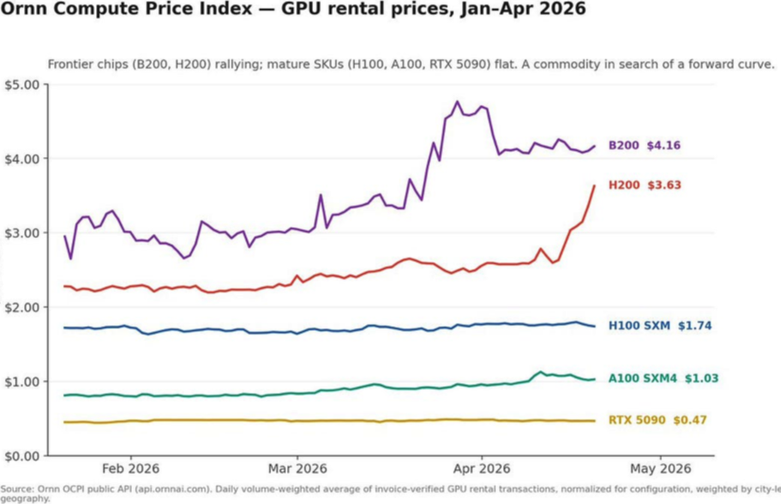
Ornn Index cleared prices (in $/GPU hour) across different GPUs
Ornn has the H100 SXM clearing around $1.70-$1.80/GPU-hour, the H200 trading in the $2.20 to $3.60 range, and B200 (the newest flagship) between $2.66 and $4.75 over the last 2.5 months. This volatility mimics commodity behavior when it has demand but not a well-developed forward curve.
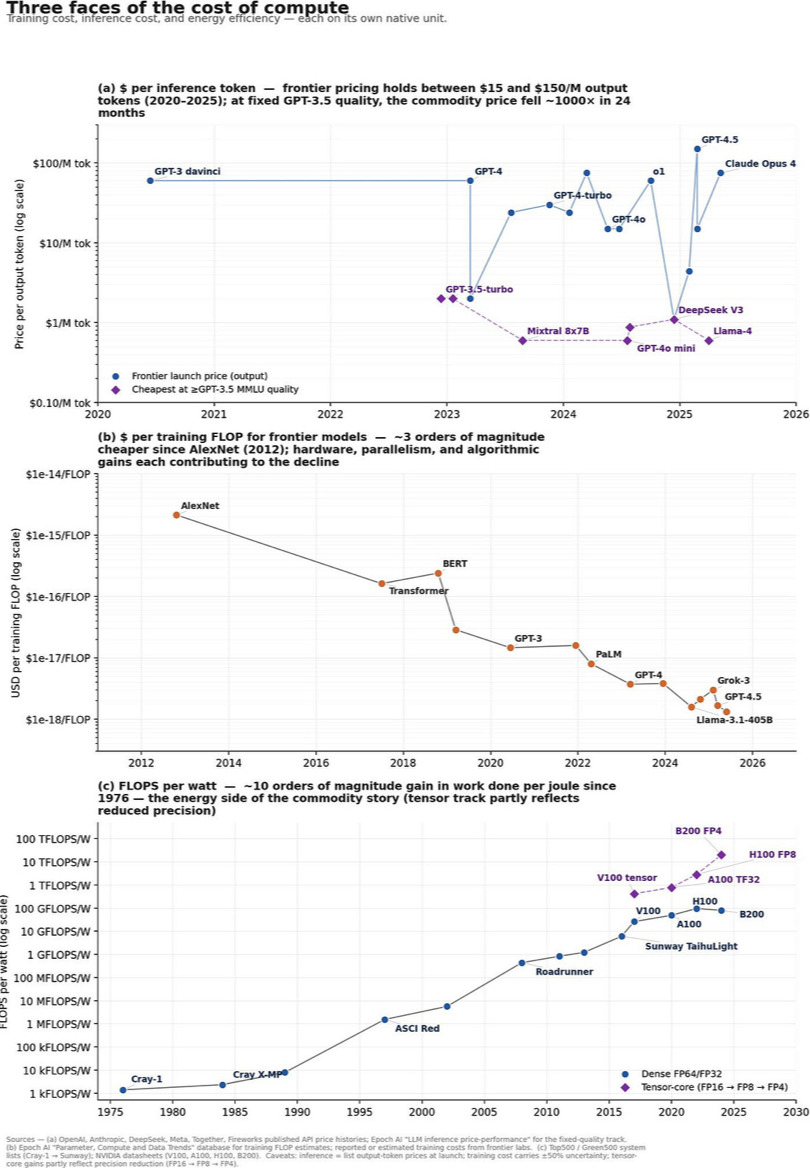
The amount of operations (FLOPs) per unit of power (watt) has increased by orders of magnitude over the last 5 decades, while the dollar cost per operation for training models has tended to decrease through advances in hardware and optimization.
Demand is compounding at roughly 25% a year on AI-specific workloads. The IEA now expects global data-center electricity use by 2030 to reach around 945 terawatt-hours (as a base case), which is more than Japan’s entire grid uses today (IEA). ERCOT’s 2030 large-load forecast moved from ~30 GW to ~50 GW in a single year, driven mostly by data centers. The ADMIS research desk, which evaluates data center growth from the power side, puts the top four hyperscalers (AWS, Azure, Google Cloud, and Meta) at something like 78% of global self-built critical IT power capacity (ADMIS). Microsoft has contracted roughly 40 GW of clean power offtake as of late 2025. Meta and Amazon each bought just over 10 GW of PPA capacity in 2025 alone.
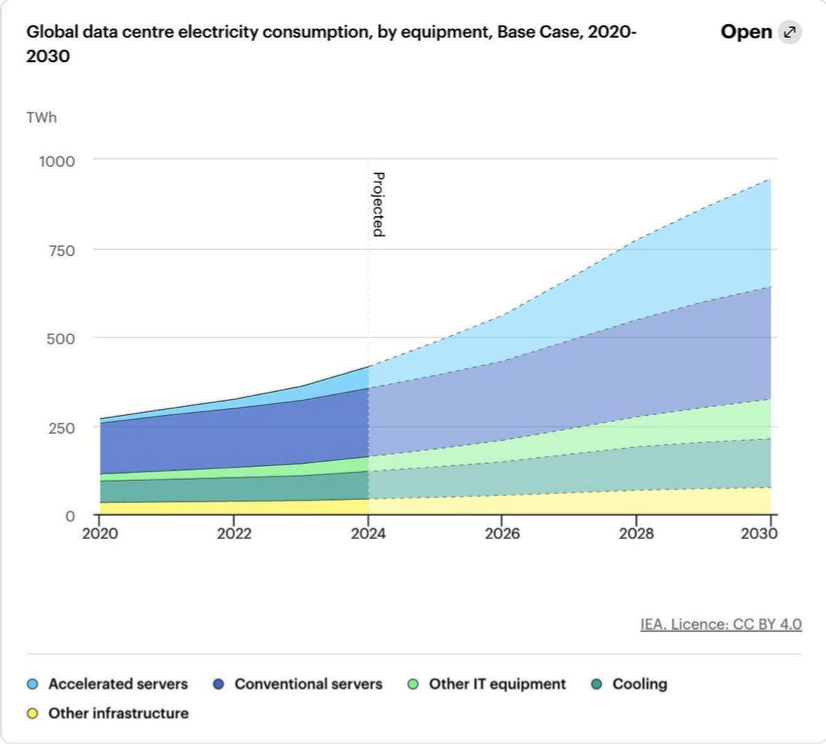
Global data centre electricity consumption, by equipment, Base Case, 2020-2030
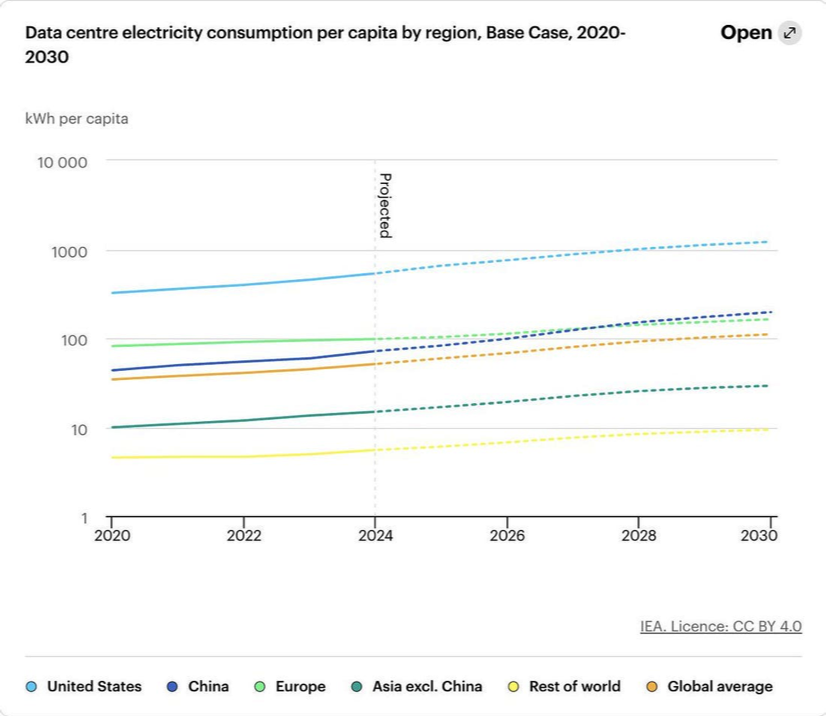
Source: IEA Reports
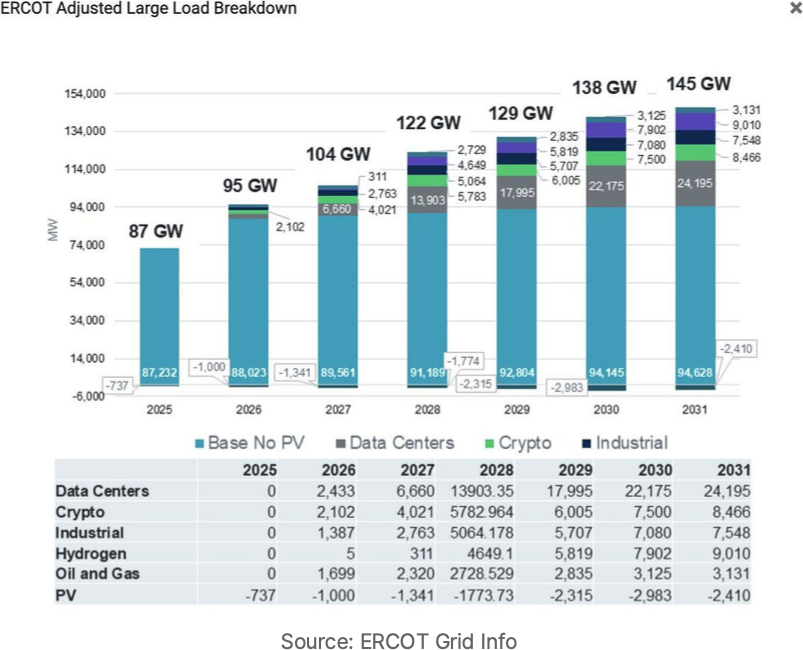
Source: ERCOT Grid Info
A quick note if you haven’t spent time in power markets: A power purchase agreement (PPA) or offtake agreement is a long-dated contract where a buyer promises to purchase electricity from a specific generator at a specific price. PPAs are typically the backbone of new renewable and nuclear construction, because they provide the revenue certainty against which lenders underwrite the debt used to finance these projects. Historically, these contracts were signed by utilities and the occasional aluminum smelter. The hyperscalers adopted the mechanism wholesale, and immediately started using it at a scale no corporate buyer has ever used before. To calibrate on the size of these future power purchases: NYC’s entire peak electricity demand is ~11 GW. Texas’s ERCOT grid peaks ~87 GW.
Total installed US wind capacity is ~150 GW. Microsoft’s 40 GW of contracted offtake is about a quarter of the American wind fleet, sitting on one company’s balance sheet. Meta and Amazon each writing just over 10 GW of fresh PPAs in 2025 alone means each is procuring more long-dated electricity than most utilities. This becomes closer to sovereign-scale energy procurement with a Mag 7 logo on the term sheet.
A useful framework for why this matters: every efficiency breakthrough actually makes compute more valuable, not less. Google’s TurboQuant, announced just a month ago, claims a 6x reduction in KV-cache memory without accuracy loss. Forbes called it the end of brute-force scaling: “The top labs are now competing not only on model size and capability but also on efficiency and cost. Google’s announcement is a signal that optimization is now a first-class problem, not an afterthought.”
TechRadar noted, with the right kind of weary, that compression is a cache-line optimization (i.e. packing more useful work into a given chunk of memory), not a RAM-price fix (which would make memory itself cheaper). Why is this important? The 19th-century steam engine nearly doubled its efficiency between 1820 and 1860, and Britain burned more coal, not less. In fact, William Stanley Jevons, a British economist, wrote a book about it, leading to what is now called Jevons paradox.
“It is wholly a confusion of ideas to suppose that the economical use of fuel is equivalent to a diminished consumption. The very contrary is the truth.”
Jevons paradox for elastic goods: the reduction in cost leads to a much larger surge in demand. When you see this kind of curve in an input, every buyer of that input eventually wants to lock in a price. That is what power markets figured out fifty years ago. (To be continued).