
Traditional Power Markets Are The Analog
Every major commodity spends its early years being sold under a semi-fungible umbrella, before the market microstructure develops and aims to differentiate and standardize. Oil was oil before WTI and Brent became global standards with their own futures curves, and before diesel, jet fuel, and gasoline each got their own crack spreads. Coal was coal before coking and steam split apart. Natural gas was natural gas before Henry Hub, AECO, and TTF were established. Compute is being marketed as “compute,” and it’s at least three volatile personalities stacked under one large trench coat.
The chip. A hyperscaler buys H100s from Nvidia the way an airline buys a 787 from Boeing. It’s a capital asset, long-dated, with a depreciation schedule and resale market. The GPU-hour. Renting a GPU by the hour is like renting a car. The car has a fixed horsepower rating, and you owe the rental agency whether you drive it across the country or leave it parked at the airport. GPU-hours are largely fungible (within specific conditions): an H100-hour from CoreWeave looks a lot like an H100-hour from AWS for a given workload, which is the thing that makes index products plausible.
The token. This is where the comparison to fuel is perhaps the most appropriate. In the current environment, tokens are analogous to gasoline that has been blended, additized, and branded at a specific refinery. Tokens aren’t easily fungible or comparable across providers.
What’s A Compute Token By Another Name?
OpenAI currently bills GPT-5.4 at $2.50 per million input tokens and $15 per million output. Anthropic bills Claude Opus 4.7 at $5 per million input and $25 per million output tokens. Google prices Gemini 3 Pro at $2/$12. The numbers are easy to compare. The underlying units are not.
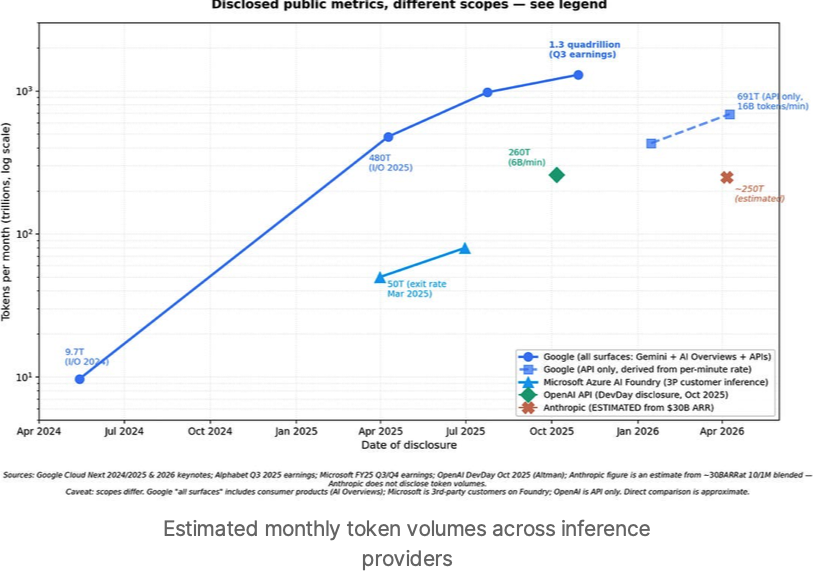
Estimated monthly token volumes across inference providers
Each provider uses its own tokenizer: OpenAI uses tiktoken, whereas Anthropic and Google each use their own proprietary schemes. If we input the exact same paragraph into GPT-5 and Claude, the latter will slice it into 2-3x as many tokens (see Propel and VentureBeat). Headline prices are therefore not comparable line for line.
“A dollar of Claude” and “a dollar of GPT-5” buy different amounts of work before you even argue about which answer is better. The unit the buyer actually wants (i.e., intellectual work completed) doesn’t have a published conversion table across providers. Even if tokenization were standardized, the unit would still fail as a financial primitive because its extrinsic value is non-stationary. The same prompt can produce materially different outputs across time, models, and even across API calls, as providers continuously update weights, routing, and inference policies. A “token” maps to a stochastic unit, and its value drifts with inference model quality, making it extremely difficult to anchor a forward curve or define a hedgeable contract.
Underneath the API layer is the retail subscription mechanism. Flat-fee subscriptions, priced like utility service, with no visible link to the marginal compute cost of any given prompt. The provider’s revenue is the spread between subscription revenue in and per-token serving cost out, and when inference demand surges, that spread compresses. This is where a frontier lab becomes capacity-constrained.
Power Markets Are Convenient Templates
Electricity is the most useful mental model for compute, as long as we distinguish the underlying layers. Power trades at two layers: Capacity layer in MW; the right to call on generation Energy layer in $/MWh; the electrons actually delivered Across different energy zones, there are established forward curves, swaps, and mature hedging strategies. Day-ahead blocks, real-time imbalance, FTRs, ancillary services, locational marginal prices, capacity auctions, unit-contingent PPAs. The whole complex operates because both layers have published prices, forward curves, and a clearinghouse between the parties. The layman’s primer on energy hedging describes layering financial instruments (swaps, futures) on top of physical ones (PPAs, unit-contingent offtake), sized monthly, re-evaluated against Gross Margin at Risk.
Compute is still trying to catch up one layer at a time. The Ornn Compute Price Index went live on Bloomberg in April, built on cleared transaction prices rather than surveys, weighted by region and volume. Centralized and decentralized venues have queued up exchange-traded GPU-hour perpetual futures, pending regulatory approval. Kush Bavaria, co-founder and CEO of Ornn, has written about the index on equal footing with the S&P 500, which is either the most prescient or the most premature analogy of the year, depending on how the next few cycles unfold.
Measuring the volatility of these rental rates tells its own narrative. $/GPU-hour for frontier machines (the B200, the H200) prints 40-80% annualized vol over the last 3 months. More mature SKUs clear closer to mid-teens, which is on par with equity index vol. That spread tracks where supply is still constrained and where commoditization has already happened. The H200 ripped when the Trump administration approved China sales, compressed when AWS raised list prices 15%, and wobbled on the DeepSeek efficiency cycle. This is an example of a capacity-rental price reacting to demand-side headlines, which is what electricity capacity prices do when new load hits an interconnection queue.
There’s also Compute Desk, founded in 2025, positioning itself as financial infrastructure for compute traders, encompassing three products: Signal: private deal pricing intelligence for Hopper/Blackwell/AMD Trader: RFQ/contract/escrow workflow for large deals Clear: programmatic transaction infra for inference capacity The token side has no index, no forward curve, no clearinghouse, and no standardized unit to build any of those against.
Data Centers Are Power Plants That Happen To Sell Tokens
This is where the layers fuse, as a hyperscaler campus has two cost inputs that trade on different clocks but are fundamentally linked in the long run: The market rental rate for a GPU-hour (set by chip supply, inference demand, and residual-value assumptions)
The megawatt-hour cost of keeping those GPUs fed (set by wholesale power markets, PPAs, and weather) In the short run they can diverge sharply, which is why a two-sided hedging market is practical. In the long run they are intertwined: AI load is already the marginal driver of wholesale power prices in ERCOT and PJM, and expensive power eventually crashes the resale value of less power-efficient GPUs.
ERCOT solar PPAs have been clearing in the $35 to $45/MWh range, so a 100 MW Texas site on a $40/MWh solar PPA looks like a very profitable piece of industrial real estate on a sunny afternoon (Greening Solutions, LevelTen). The caveat is that $40/MWh buys daytime-weighted intermittent power rather than 24/7 firm delivery. A fully firmed PPA (solar-plus-storage, gas-firm) clears closer to $55 to $80/MWh in ERCOT today, and inference workloads unfortunately don’t take nights off.
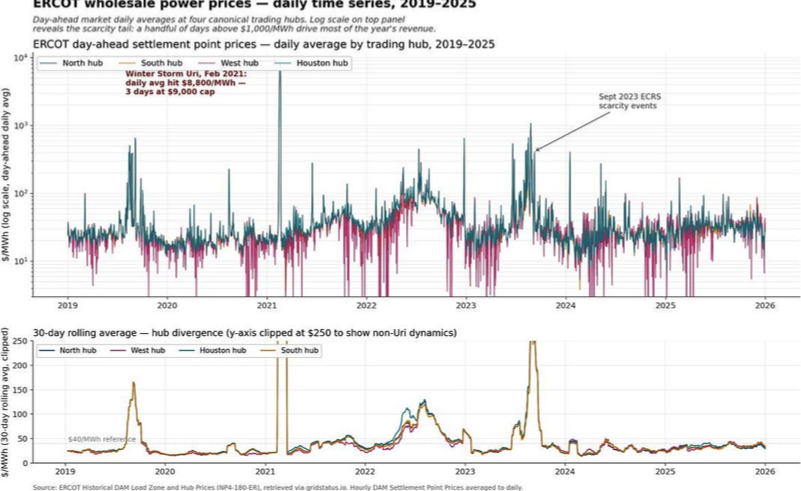
ERCOT wholesale power prices
The same site during an ERCOT scarcity event, clearing at the $5,000/MWh offer cap, burns $500,000 an hour in power. The cap was lowered from $9,000/MWh in 2022 after Winter Storm Uri (see S&P Global and Yes Energy). The compute that same site produces is roughly 67,000 H100-equivalents, using SemiAnalysis’s ~667 GPUs-per-MW all-in density figure. At $2.50 per GPU-hour, between specialist spot around $2.00 and hyperscaler on-demand at $3.00 to $3.90 (IntuitionLabs), that is about $167,000 an hour of GPU-hour revenue.
You pay three dollars on power for every dollar of compute you sell. The PPA was supposed to prevent this. The PPA fixes averages. It does not protect the bottom 100 hours of the year, which is where, it turns out, all the money goes. The counter-play is a standard merchant-plant move. Hedge the non-flexible cooling load with a vanilla swap. Curtail the flexible compute during the event. Sell the freed capacity into the real-time market.
Dispatch when the spread is on, sit on it when it isn’t. Every merchant gas plant has been booking its year this way since 1998.
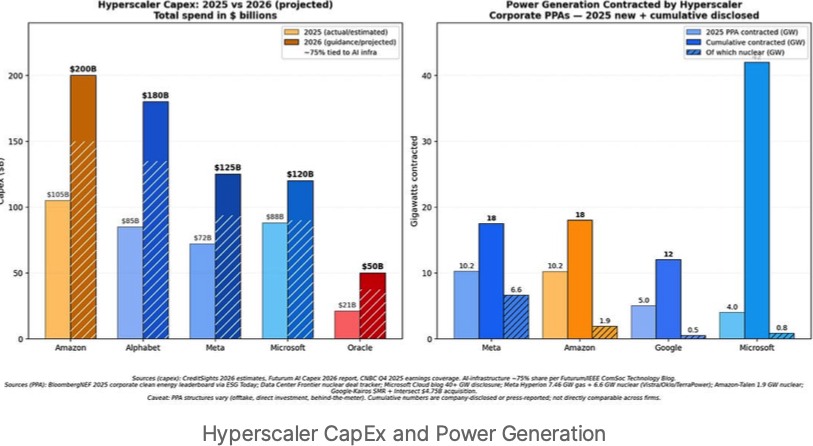
Hyperscaler CapEx and Power Generation
Meta filed with FERC in September 2025 to stand up Atem Energy, LLC as a wholesale power marketer, joining Alphabet (2010), Amazon (2015), and Microsoft (2021) in holding market-based rate authority. Microsoft signed a 20-year PPA with Constellation to restart Three Mile Island Unit 1 at 835 MW, with Constellation spending ~$1.6 billion on the restart. Google closed its $4.75 billion acquisition of Intersect Power in March 2026, the first time a hyperscaler bought a developer outright rather than signing offtake.
The hyperscalers are, quietly, becoming the largest independent power producers in North America. They are also integrating across every hedgeable layer of the stack: owning the chips (capex), contracting or producing the power (input cost), and controlling distribution via APIs (pricing). What they still lack is a standardized, tradeable unit on the output side (tokens), leaving them with an unhedgeable short on tokens.
Throwing A (Forward) Curveball For Tokens
Anthropic, OpenAI, and every frontier lab are running a dynamic cash-flow optimization problem; they’ve sold subscriptions and API contracts at fixed prices, and the token-denominated cost of serving those promises can rip against them. Ben Thompson framed this earlier as opportunity cost, which is downstream of the same gap. Anthropic has reportedly been throttling Claude’s output quality through the past few months because they do not have capacity to serve every customer. If the frontier labs could buy forward tokens at a known price, they could honestly underwrite fixed-price enterprise contracts that today they cannot.
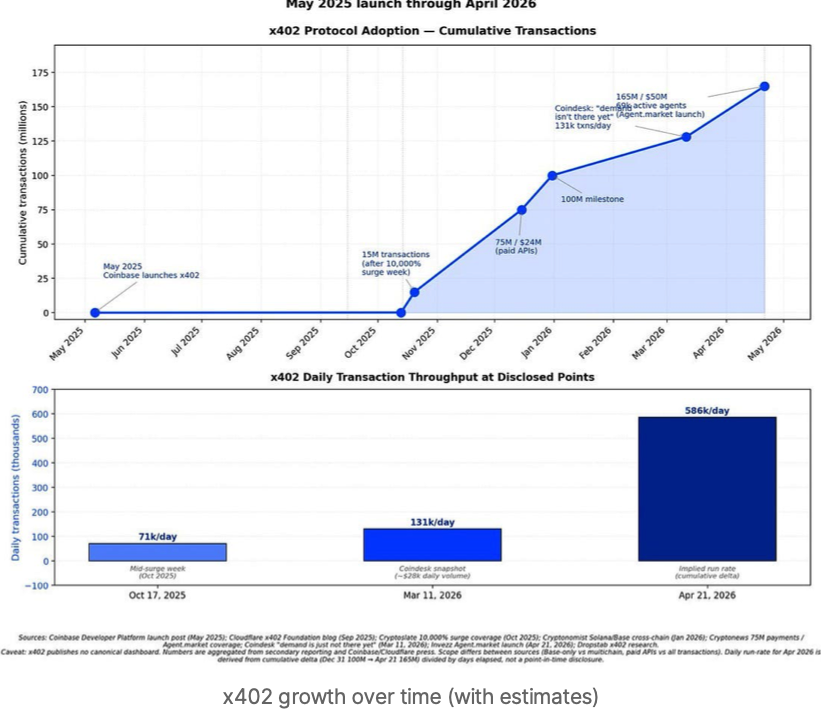
x402 growth over time (with estimates)
On the buy side, the expansion of the agentic stack makes this acute. Coinbase’s x402 protocol, now layered under Google’s Agent Payments Protocol, lets autonomous agents pay per API call in stablecoins. As of March 2026, x402 was clearing roughly 131,000 transactions per day, for ~$28,000 in daily volume. The absolute number is small; the direction of travel is that every agent is an atomic consumer of tokens, and none of them knows what their per-call price will look like in six months. A procurement agent that autopays $0.003 per call today is implicitly long Claude-Opus-tokens at today’s price. Multiply that by an entire agentic economy. Someone will want to sell them a strip. Writing that strip requires a standardized token to settle against.
Where To Go From Here?
Wood to coal took ~60y to cross from 5% to 50% globally, and coal to oil was similar. Each transition produced the instruments that made the underlying tradable: bilateral coal forwards in the 19th century, the WTI complex in 1983, natural gas swaps in the 1990s, capacity markets and locational prices in the 2000s. The derivatives followed the physical market by a handful of decades.
Compute’s physical market is about five years old in any recognizable form. Capacity-layer derivatives are already arriving. Energy-layer derivatives, the “token forward,” are waiting on something more complex: a standardized token. Until “one unit of frontier intelligence” is a comparable, published index number, there is nothing to write a futures contract against.
Compute is cheap in the same way electricity was cheap in 1905: briefly, and right before we decided to run every factory, streetcar, and household on it. We are at the beginning of the expensive-power and hedgeable-compute era. Because the standards are still being established, and indices are in their infancy, short-dated forwards (when they exist) are purely relationship-priced OTC.
Every business that ingests compute as a cost line will eventually hedge compute as a cost line.