
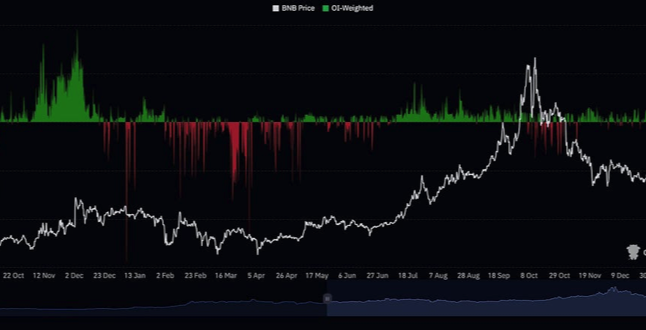
CT loves to conflate delta-neutral with risk-free, so here’s your reminder: “It ain’t what you don’t know that gets you into trouble. It’s what you know for sure that just ain’t so. “– Mark Twain So what’s there to consider? “Delta-neutral” trades involve going long one instrument and short another (typically on the same underlying asset), expecting the prices between the two instruments to converge, instead of taking a view on whether prices themselves will go up or down.
One example is a “funding” or “basis” trade, where traders are trying to capture the spread between spot assets and perps → this spread comes from the funding rate paid or received between buyers/sellers of perps to balance the market.
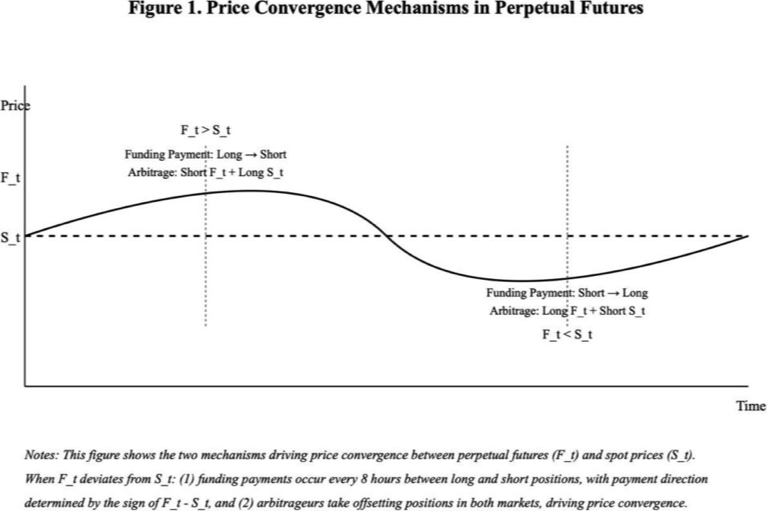
(The role funding rates play to balance buyers/sellers of perps, in driving convergence between spot and perp prices.)
Basis trades in crypto typically come in three forms:
1. Long spot / short perps → funding rates are very positive (more perp buyers than sellers), and traders are trying to collect +ve funding.
2. Short spot / long perps → when funding rates go very negative (more perp sellers than buyers): you can only put this on if you already hold the spot or can source a borrow at a rate < what you expect to collect in -ve funding.
3. Long/short perps across venues → when funding rates for perps on the same asset diverge significantly enough across exchanges
Why This Isn’t as Simple as It Sounds
Capital (in)efficiency kills you on altcoins.
Funding rates on long-tail assets can dwarf what you often see on BTC/ETH, even in massive risk-on environments. Why? Because most venues won’t let you post a random altcoin as collateral against perps. That means you’re tying up capital on both legs → buying spot AND separately posting collateral for the short perp position. So for $100 long/short exposure, you actually need >$100 of capital put to use (depending on your leverage level) → it takes a larger size to compress these funding dislocations.
This is why players with large balance sheets (read: funds, market-makers, etc.) can execute this in massive size, given their cost of capital. Moreover, in a rising market environment, you still need to have enough capital to continuously top-up the short-perp leg, or collateralize your margin account with assets that are positively correlated to the market (e.g. BTC/ETH/high-quality liquid assets).
When funding goes supremely negative (often in risk-off environments, or due to hedging pressure), not everyone has access to the token inventory to sell spot / go long perps (pretty much only market-makers with DMM deals, OTC borrowers, etc.) → funding rates can remain negative for extended periods of time.
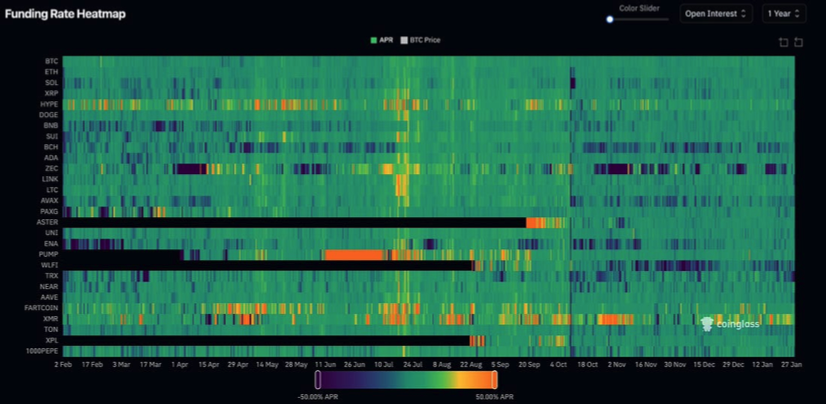
(Funding heatmap from Coinglass)
Liquidity + funding mechanisms vary drastically across venues. A perp on the same altcoin might have deep OI on one exchange and nothing on another. Funding rates can look very attractive, but if you can’t get in/out of a position without paying massive slippage, that funding PnL can erode very quickly (execution matters!).
Some exchanges (like Deribit) use continuous-time funding, so the funding you pay/receive is a function of your holding time for a position, as well as the funding rate. Other CEXs snapshot the funding rate at the end of a funding window, and only care about what the funding is during the snapshot to compute the funding payment. Exchanges can also differ meaningfully on their “mark price” calculations (used to calculate liquidation thresholds, PnL, etc), as well as caps/floors (called “clamps”) on funding rates.
These minor details that seem benign in sideways environments can matter a lot during volatile markets (think FTX collapse, or 10Oct2025 more recently).
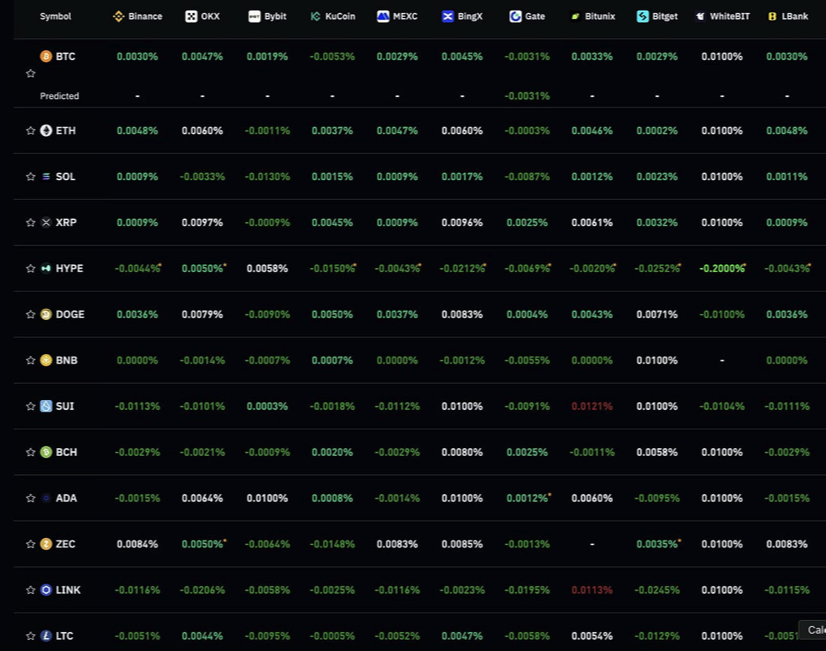
(Funding rate differentials across assets and exchanges)
When the delta becomes non-neutral.
Liquidations. If the market moves against your perp leg and you can’t top up collateral fast enough, you’re no longer delta-neutral. In a trending market, this can accidentally generate +ve PnL if momentum continues — profit from the spot leg, after being stopped out of the perp position. But in pump-and-dump moves (more often the case), prices revert post-liquidation → massive losses.
Auto-deleveraging (ADL). Exchanges (should) prioritize solvency to ensure buyers and sellers are made whole, especially in highly volatile market conditions. For the sake of risk management, they’ll take it upon themselves to close out profitable positions. If you get ADL’d, you’re no longer delta-neutral—suddenly you’re taking directional exposure whether you wanted it or not.
Expecting the (un)expected.
Rule changes. Exchanges can and do change funding mechanics (clamps, payment frequencies, payout windows, etc.), and collateral requirements mid-trade. That “locked-in” spread you calculated? Not so locked. Who’s your counterparty? This risk goes beyond basis trades, but every time a trader posts collateral to a centralized exchange / custodial account, they are explicitly taking credit/counterparty risk (think FTX!). So when considering whether the rate of return on a funding trade is worth the cost of capital, it’s important to price in the incremental credit risk you’re taking.
Bottom Line
Basis trades work at scale when you have a sizable balance sheet, sufficient liquidity, and operational infrastructure to manage tail risks. For everyone else, that funding rate arb isn’t free money—it’s compensation for capital, market, operational, and counterparty risk.